Harris tweed maker drops 'Scottish' marketing over Lockerbie release The biggest manufacturer of Harris tweed has dropped the word "Scottish" from its marketing campaign in America amid fears of a consumer backlash over the release of the Lockerbie bomber. By Auslan Cramb,
13 Sep 2009
Harris Tweed Hebrides said it had to “de-Scottishify” the product after receiving feedback that sales could suffer. The company, whose chairman, Brian Wilson, a former government minister, believes it was a mistake to release Abdelbaset Ali Mohmed Al Megrahi, has removed references to Scotland and Scottish imagery from its promotional material. Instead, the firm plans to use a neutral image of a model in a tweed frock coat reclining on a couch.
Mark Hogarth, the company's creative director, said it had decided to focus on the brand's island heritage rather than its Scottish credentials ahead of the launch of its fashion collection in New York next month. He said that he was forced to rethink the marketing campaign because of the anti-Scottish backlash that followed the release of Megrahi, 57, who is terminally ill, last month.
“We are not going to promote ourselves as a Scottish company as we would previously have done,” said Mr Hogarth. “From everyone we spoke to in the US, the feeling came back that a serious mistake had been made in releasing Megrahi. It really wasn't seen as a British decision in the media there, but a Scottish one. While in Scotland and in the UK as a whole there may be a sense of ambivalence about Megrahi's guilt, in the US they are very much as one.
“We have been getting a lot of feedback and we have had to de-Scottishify the image of the brand. If he had not been released we would not have altered anything. We had hoped to increase the proportion of our US sales to double digits within a year and then see double digit growth in the year after that, but that could be seriously affected. We are quite worried.”
----------------
So, they're relying on the average consumer's ignorance to protect against the effects of their ignorance...
Gareth Peirce is a defence lawyer who has represented many men and women in their appeals against wrongful convictions made on the basis of disputed scientific evidence, misidentification and police malpractice.
i think she worked with craig murray as well. murray reckons 'the FCO and MI6 knew that al-Megrahi was not the Lockerbie bomber'
i've not watched this yet so don't know what its like, but the few doha debates i've seen in the past have been alright
The Doha Debates focus on the early release of the Lockerbie bomber to Libya
TRNN releases this video as part of a content sharing agreement with Doha Debates.
The Doha Debates are chaired by the award-winning former BBC correspondent and interviewer Tim Sebastian, who founded them in 2004 and secured their editorial independence.
The Doha Debates states that although the Debates are financed by the Qatar Foundation for Education, Science and Community Development, no government, official body or broadcaster has any control over what is said at the sessions or who is invited.
The debates focus on a single, controversial motion, with two speakers for and against. Once they have outlined their arguments, each speaker is questioned by the chairman and the discussion is then opened up to the audience for argument and a final electronic vote.
The 350-strong audiences are drawn mainly from Qatars student body and come from all over the Arab and Islamic worlds.
George Galloway was briefly on the Scottish news this evening talking about how he'd, as opposed to the members of the Scottish government, be happy to go to answer questions about Al Megrahi at the Senate.
That could have been outstanding if he'd gone again.
Alex Salmond spares the US Senate another painful defeat in BP inquiry Scotland's first minister has turned down a request to testify in the US about Libya, BP and the release of the Lockerbie bomber
Kevin McKenna
The Observer,
25 July 2010
Senator John Kerry ought to be more careful about what he wishes for. The chair of the US Senate's foreign relations committee wants Alex Salmond to appear at a hearing this week into the release of the only man convicted of the Lockerbie bombing.
America's attitude towards historical accuracy is fractious. Yet even the senator and his colleagues can't have forgotten what happened five years ago, when a loquacious Scot last made a guest appearance in their house. Then, George Galloway, one of the most gifted Scottish politicians of his generation, stood before a senate sub-committee and eviscerated it. That, too, was about the black stuff. They had lamely accused him of profiting from Iraqi oil sales. But what happened next still causes some old Republicans to send for nurse whenever they hear a Scottish accent. Someone should tell Kerry that Scotland's first minister is more than capable of matching Galloway's performance.
In any case, Salmond and his justice minister, Kenny MacAskill, have decided to spare the senators another home defeat by rebuffing their invitation. They know Thursday's hearing is merely posturing before the mid-term elections. Any US politician who can succeed in dragging BP on to another penitent's stool for a thrashing will garner a few extra redneck votes in the south. Indeed, it is surprising that it took them so long to spot the potential in looking at possible BP collusion in the release last August of Abdelbaset al-Megrahi to advance a Libyan oil deal.
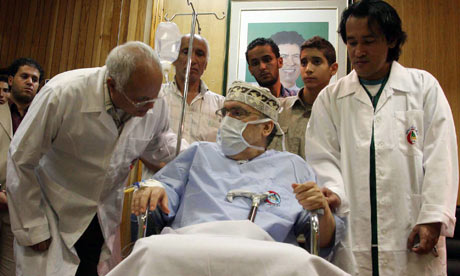
Many believe it is good that Salmond has chosen not to participate in this charade, and that the decision to free the Libyan on compassionate grounds was a proud day for Scotland. Corroborated expert medical opinion had stated that it was likely al-Megrahi, pictured, would die of prostate cancer within a few months. That he clings still to a life of sorts is immaterial. Releasing him in these circumstances showed the world that devolved Scotland is an enlightened nation not wedded to vengeance.
It would be something for sure - Salmond has a great way of smiling when attacking and I'm sure he'd have done a great job if he'd gone. I'm not too keen on Kenny McAskill though, he has almost the tone of a headmaster telling the schoolchildren what's going on.
US Senators postpone Lockerbie BP hearing over lack of witnesses US Senators have postponed a hearing to investigate BP’s alleged role in the release of the Lockerbie bomber after the oil giant and British officials “stonewalled” requests for information.
Robert Winnett in Washington
27 Jul 2010
telegraph.co.uk
The US Senate was forced to abandon this Thursday’s hearing after former ministers and senior BP executives refused to appear. Those shunning invitations included Jack Straw, the former Justice Secretary, and Tony Hayward, the outgoing chief executive of BP. The British Government has also failed to release documents requested by Senators in time. The information is currently being reviewed by the Cabinet Secretary.
The postponement of the hearing is likely to fuel growing American suspicion that a BP oil deal may have played a part in the release of the Lockerbie bomber last year — despite categorical denials from the British and Scottish governments that this was the case.
The refusal of Tony Hayward, who announced his resignation on Tuesday, to travel to Washington was attacked by senior senators who said the company was already on “thin ice with the American people”. Senators are to continue pushing for Mr Hayward to appear at a later date, saying they wanted to question him over whether BP “advocated trading blood for oil”.
The firm is also refusing to allow Sir Mark Allen- a former MI6 official who helped negotiate a valuable Libyan oil contract for BP with Colonel Gaddafi — to appear at the hearing. BP has admitted that Sir Mark, an adviser to the firm, also spoke to Mr Straw about Britain introducing a prisoner transfer agreement with Libya. BP announced that it would instead send Peter Mather, the company’s head of UK operations to appear before the Senate hearing. However, this was not acceptable to the senators.
Robert Menéndez, a Democratic senator from New Jersey, said: “I would have thought that a company on thin ice with the American people for devastating the Gulf Coast would want to fully co-operate with our effort to fully understand the release of a terrorist who murdered 189 Americans”. Mr Menéndez accused BP and Mr Hayward of being consumed by his “multi-million dollar golden parachute” as he steps down as the company’s chief executive.
The senator vowed to keep pressing for Hayward to testify on “serious lingering questions about whether the company advocated trading blood for oil” and pressed for the bomber’s release to safeguard a lucrative deal with Libya.
The hearing had been called to examine BP’s alleged role in Scotland’s decision last August to release Abdelbaset al-Megrahi, the only man convicted over the 1988 bombing of a Pan-Am flight that killed 270 people. The Scottish authorities freed al-Megrahi on compassionate grounds after being assured he suffered from terminal cancer and had three months to live – but nearly a year later, he is alive in his native Libya. The Scottish Government has denied that BP played any role in the release of al-Megrahi.
US Oil Companies lobbied ‘Lockerbie’ Senator to protect Libya
New information has emerged showing the extent of lobbying of the US Senate by US oil firms over business deals with Libya.
It reveals that US oil companies wanted Libya excluded from new legislation that would have allowed American victims of state sponsored terrorism to sue the countries responsible as well as firms operating within those countries.
The amendment to remove Libya from the bill was co-sponsored by Frank Lautenberg – one of the four senators currently claiming BP lobbied for Al Megrahi’s release. The revelation will fuel calls for those US Senators, keen to investigate any business involvement with the case of Abdelbaset Al Megrahi, to start with companies at home.
The information shows:
* US Oil companies were the chief lobbyists to have Libya excluded from legislation allowing American victims of state sponsored terrorism to sue responsible countries or US firms operating in those countries.
* The legislation removing Libya from the bill was co-sponsored by Frank Lautenberg – one of the four senators currently claiming BP lobbied for Al Megrahi’s release.
* Reports in the New York Times when the legislation – which prevented the families of victims of the Lockerbie bombing suing Libya was introduced – state that ConocoPhillips, Marathon Oil, Amerada Hess and Occidental all lobbied alongside the Libyan Government. These firms, along with an Oil industry lobby group and supported by ExxonMobil, Chevron and Dow Chemical all lobbied US senators to pass the amendment exempting Libya.
* The amendment passed unanimously with no Senator speaking out against it.
Questions have also been raised over the role of the US-Libya Business Association and a trade deal signed between the US and Libya in May 2010 which highlighted oil as Libya’s major export to the USA.
SNP MSP Christine Grahame who has repeatedly urged the US Senators to investigate their own back yard said:
"This is another example of utter hypocrisy from the senators involved.
“Before they go making accusations at other countries and other companies they should look closely in their own back yard.”
Ms Graham criticised the reluctance of the Senate Hearing to speak to US oil firms adding:
"As yet they have failed to call Exxon Mobil – a key member of the UK Libya Business council whose activities so concerned them.
"They have not called in US CIA agents involved in negotiations with Libya and despite their concern over the UK’s deal in the desert – a concern I share – they do not seem to have any problems with their own Government signing trade deals based on oil with Libya.
"If I was running their inquiry I would certainly want to know if US companies and trade negotiators discussed Al Megrahi."
Ms Graham highlighted the role of Senator Lautenberg in protecting Libya from lawsuits and called on the Senate Committee to join the growing calls for a full international inquiry into the Lockerbie tragedy.
"Above all we now know that one of the US Senators laying accusations against the Scottish Government and BP put forward legislation on behalf of the Libyan Government and US Oil companies that stops American citizens pursuing Libya in the courts over this or any other terrorist act.
"I do not doubt the Senators care and concern for the families of the victims of the Lockerbie bombing and I share their desire to get to the truth over the bombing but would urge them to join me in backing a full international inquiry into the atrocity. Their hypocrisy in making allegations against the Scottish Government when they themselves have acted in favour of US oil and Libyan Government lobbying is deeply distasteful."
New oil find
The revelations follow the announcement by Libya's Waha oil Company (WOC) of a new major oil find in the country.
WOC said in its website that it had made a new discovery in the Sirte basin, 80 km south east of the area of Marada. The company said the output of the well of Lidam layer was 1.080 ppd and 0.86 million cubic meters of gas per day. The output of the lower white layer was 1.704 million ppd and 0.025 million cubic meters of gas per day.
Waha Oil Company is considered to be the second biggest oil producer in Libya, it is owned by National Oil Corporation (NOC) in a joint venture with three American companies namely:
ConocoPhillips, Marathon and Amerada Hess.
These companies have been working as partners since Jan 2006.
U.S.-Libyan relations
According to Reuters, the following are some important events in U.S.-Libyan relations:
* January 1986 - U.S. President Ronald Reagan orders halt to economic and commercial relations with Libya, freezes Libyan assets in the United States.
* April 1986 - U.S. blames Libya for bombing of West Berlin disco used by U.S. military personnel that killed three people and wounded more than 200.
* April 1986 - U.S. aircraft bomb Tripoli, Benghazi and the home of Libyan leader Muammar Gaddafi. Libya says more than 40 people are killed, including Gaddafi's adopted baby daughter.
* December 1988 - Pan Am flight 103 from London to New York is blown up over Scotland, killing 259 people on board and 11 people on the ground in Lockerbie.
* April 1999 - Libya hands over two suspects in the Pan Am bombing. They stand trial in the Netherlands under Scottish law.
* January 2001 - One suspect is found guilty of murder and given a mandatory life sentence. The other is acquitted.
* March 2003 - Libya reaches political agreement with the United States and Britain to accept civil responsibility for the bombing. Libya agrees to pay about $2.7 billion.
Libya says it will abandon weapons of mass destruction programs and allow international inspectors.
* June 2004 - U.S. and Libya resume diplomatic ties after 24 years.
* September 2004 - President George W. Bush formally ends U.S. trade embargo on Libya, rewarding it for giving up weapons of mass destruction, but leaves some terrorism-related sanctions in place.
* January 2008 - Mohammed Abdel-Rahman Shalgam, Libya's foreign minister, declares an end to confrontation with the United States during a visit to Washington, the first by a Libyan foreign minister since 1972.
* August 2008 - Libya and the United States sign a deal to compensate all U.S. and Libyan victims of bombings or their relatives.
* September 2008 - Condoleezza Rice meets Gaddafi in Tripoli during the first visit by a U.S. secretary of state to Libya since 1953.
* July 2009 - Gaddafi and U.S. President Barack Obama shake hands at a world leaders' dinner during a G8 summit in Italy.
Bribery at the heart of Megrahi’s Lockerbie conviction?
While Libya continues to burn, an eerie silence has descended over the British media’s interest in reopening the uncertainties surrounding the Lockerbie bombing. The occasional defecting Libyan minister has pretended to hold previously untold secrets, but nothing has come of them
It was left to Al Jazeera English to try to lance the boil last Thursday when the channel broadcast an explosive documentary on the subject. The programme makers had gained access to the unpublished report of the Scottish Criminal Cases Review Commission into the case.
Even more importantly, they managed to see the notebooks and diaries of the Scottish and American investigators written at the time. These were also in the possession of the Review Commission.
In short, the diaries make a blistering allegation – that the central Maltese witness whose testimony was key to convicting Abdelbaset al-Megrahi – had been bribed. The diaries record the apparent “offer of inducements made to Tony Gauci”, the Maltese shopkeeper who identified clothes that were found in the suitcase that carried the bomb on the plane, as having been bought at his shop by al-Megrahi.
Tony Gauci’s brother, Paul, it is claimed, in the same diaries as having “a clear desire to gain financial benefit”. The Review Commissions’ own report states that after the trial Tony Gauci was paid $2 million, and that brother Paul got $1 million reward money.
If true, these would be completely dynamite revelations. Of course, they would have come out in the appeal that Megrahi’s release prevented happening. It is inconceivable that this Scottish Review Commission’s report would not have surfaced at such an appeal. Does this perhaps explain why he was eventually bundled so speedily out of the country?
But the other question remains… why was it left to Al Jazeera to make these allegations?
You cannot post new topics in this forum You cannot reply to topics in this forum You cannot edit your posts in this forum You cannot delete your posts in this forum You cannot vote in polls in this forum You cannot attach files in this forum You cannot download files in this forum